Loading...

What Is Cryptocurrency? A Beginner’s Guide
If you've heard people talk about Bitcoin, crypto wallets, or "buying the dip" and felt a little lost, you're not alone. Cryptocurrency tends to get explained in two extremes: either as the future of money about to make everyone rich, or as a confusing scam nobody sensible should touch.
Neither is accurate, and somewhere in the middle is where more than 560 million people worldwide who already own some form of cryptocurrency actually sit.
This guide skips the hype and the fear. By the end, you'll understand what cryptocurrency actually is, how it works at a basic level, and what to weigh before you get involved. No prior experience needed.
What Is Cryptocurrency?
Cryptocurrency is digital money that exists only electronically. There are no physical coins or notes. Ownership and transactions are instead recorded on a shared, public ledger called a blockchain.
Two things separate cryptocurrency from the money sitting in your bank account: decentralization and cryptographic security. No single bank, company, or government controls it.
A network of computers spread around the world maintains and verifies the records instead, and cryptography, the same branch of math that secures online banking, makes those records extremely difficult to fake or alter after the fact.
Bitcoin, launched in 2009, was the first cryptocurrency and remains the most well known. Thousands of others have followed since, each built for a different purpose, from Ethereum's programmable "smart contracts" to stablecoins designed to hold a steady price.
How Does Cryptocurrency Actually Work?
At a basic level, here's what happens when someone sends cryptocurrency:
- A transaction is broadcast to the network, for example, "send 0.01 Bitcoin from Wallet A to Wallet B."
- Computers on the network, often called nodes or miners, check that the sender actually has the funds and hasn't already spent them elsewhere.
- Once verified, the transaction is bundled with others into a "block" and added permanently to the blockchain, a record every participant on the network can see.
- The transaction is complete and visible on the public ledger, though wallet addresses are generally not directly tied to real names.
No bank approval, no waiting for business hours, and no single company deciding whether the transaction goes through.
That's the simplified version. For the full technical picture of how blocks are actually built and secured, How Does Blockchain Technology Work? breaks it down step by step. And if unfamiliar words like "wallet" or "node" are slowing you down, keep Common Crypto Terms Every Beginner Should Know open in another tab as you read.

What Makes Cryptocurrency Different From Regular Money?
It actually helps to see the two side by side:
| Traditional Money | Cryptocurrency | |
|---|---|---|
| Issued by | Central banks and governments | No single issuer, for most cryptocurrencies |
| Controlled by | Banks and financial institutions | A distributed network of computers |
| Where it's stored | Bank accounts | Digital wallets, software or hardware |
| Cross-border transfers | Can take days, often with fees | Minutes, with network fees |
| Supply | Central banks can print more | Often capped or fixed by rule, e.g. Bitcoin's 21 million limit |
| Reversibility | Banks can often reverse fraud | Transactions are generally final |
That last row matters more than it might seem. Cryptocurrency gives you more direct control over your money, but it also removes the safety net of a bank stepping in when something goes wrong. That trade-off shows up again and again the deeper you go into this space.
The Main Types of Cryptocurrency You'll Hear About
Not all cryptocurrencies work the same way or serve the same purpose. Broadly, they fall into a few groups and they include:
Bitcoin: the original cryptocurrency, used primarily as a store of value and, increasingly, as a hedge in economies dealing with currency instability.
Altcoins: every cryptocurrency other than Bitcoin. Ethereum, for instance, introduced smart contracts: self-executing code that powers everything from decentralized apps to NFTs. Others are built around speed, privacy, or a specific industry. Bitcoin vs Altcoins: What's the Difference? covers this comparison in more depth.
Stablecoins: cryptocurrencies designed to hold a steady value, usually pegged to a currency like the US dollar. They're commonly used for payments and for holding value in crypto form without the price swings.
You don't need to understand all of these on day one. Most beginners start with Bitcoin or a small handful of well-established coins before exploring further.
What Do People Actually Use Cryptocurrency For?
Beyond speculation, cryptocurrency has a few genuinely practical use cases:
Store of value. Some people hold cryptocurrency the way others hold gold: a way to preserve wealth outside the traditional banking system. This is especially relevant in countries dealing with high inflation or currency instability, where crypto has become a practical option rather than a novelty.
Payments and remittances. Sending money across borders through traditional channels can be slow and expensive. Cryptocurrency transactions can settle faster and, in some cases, more cheaply, though fees and speed vary by network and aren't guaranteed to beat traditional options every time.
Trading and investing. Buying and holding cryptocurrency in the hope its value rises over time is the most visible use case, and also the riskiest.
Access to decentralized finance (DeFi). Cryptocurrency is also the entry point into DeFi: lending, borrowing, and earning yield without a traditional bank. It's a deep topic on its own. What Is DeFi? A Complete Beginner's Guide is the place to start if it sounds interesting.
Is Cryptocurrency Safe? What You Need to Know About the Risks
Here's the part hype-driven content usually skips: cryptocurrency carries real risk, and it isn't for everyone.
Price volatility. Cryptocurrency prices can swing hard in short periods. What's worth $100 today could be worth $60, or $150, next month. Never put in money you can't afford to lose.
No guarantees. Unlike a bank account, no institution guarantees your funds or reverses a mistake. Send crypto to the wrong address or lose access to your wallet, and that money is typically gone for good.
Scams are common. The same features that make cryptocurrency appealing (speed, limited oversight, irreversibility) also make it attractive to scammers. Fake exchanges, phishing links, and "guaranteed returns" schemes target beginners specifically. How to Avoid Crypto Scams: Red Flags to Watch For walks through what to watch for before you start.
You are your own bank. If you choose to hold your own crypto rather than leaving it on an exchange, you're responsible for keeping your private keys and recovery phrases safe. There's no "forgot password" option.
None of this means cryptocurrency isn't worth understanding. It means going in with realistic expectations instead of hype-driven ones.
How to Actually Get Started
If you've read this far and want to explore further, here's a realistic path:
- Keep learning the basics. Understanding how wallets, exchanges, and transactions work before you put in money saves you from expensive mistakes later.
- Choose a reputable exchange. This is where you'll buy your first cryptocurrency. How to Buy Your First Cryptocurrency (Step-by-Step) walks through the process.
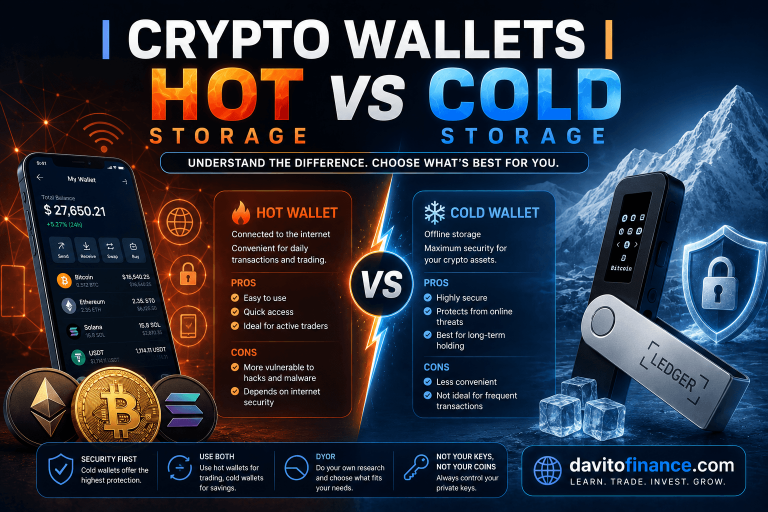
- Set up a secure wallet. Decide whether to keep your crypto on an exchange or move it to your own wallet. Crypto Wallets Explained: Hot vs Cold Storage breaks down the trade-offs.
- Start small. There's no rule that says you need to invest a lot to begin. Many people start with an amount they'd be fully fine losing while they learn.
- Keep learning as you go. This space moves quickly. Staying informed matters more than moving fast.
Want a faster, more structured way to learn this?
Reading is a great start. Actually knowing what to do with what you've learned is a different skill, and it's exactly what the Crypto/DeFi Trading Course is built to teach: real strategy, step by step, without the hype.
Frequently Asked Questions
Is cryptocurrency the same thing as Bitcoin?
No. Bitcoin was the first cryptocurrency, but it's just one of thousands that exist today. Bitcoin is to cryptocurrency what one specific bank is to "banking" in general: a well-known example, not the whole category.
Do I need a lot of money to start?
No. Most exchanges let you buy a small fraction of a coin, sometimes for just a few dollars. There's no minimum amount required to understand or participate in crypto.
Is cryptocurrency legal?
It depends on the country. Cryptocurrency is legal to buy, hold, and trade in most countries, though regulations vary and a small number of governments restrict or ban it outright. It's worth checking the specific rules where you live.
Can I lose all my money?
Yes, and that's the honest answer. Prices are volatile, and mistakes like losing wallet access or falling for a scam can mean permanent loss. Only ever invest what you can genuinely afford to lose.
Cryptocurrency isn't magic, and it isn't a scam either. It's a genuinely new way of moving and storing value, with real benefits and real risks that are worth understanding clearly before you get involved.
Ready to actually understand how to trade and invest in crypto and DeFi, not just what they are? The Crypto/DeFi Trading Course takes you from these basics to a real, working strategy.
Prefer to learn from a book, at your own pace? The Crypto Book Series covers this in more depth. If you're new to crypto, start with Book 1, then work through the series as you go.



Want to learn alongside people actually doing this? Join DavitoFinance Pro on Telegram, free, and built for people ready to stop watching from the sidelines and start building wealth together.